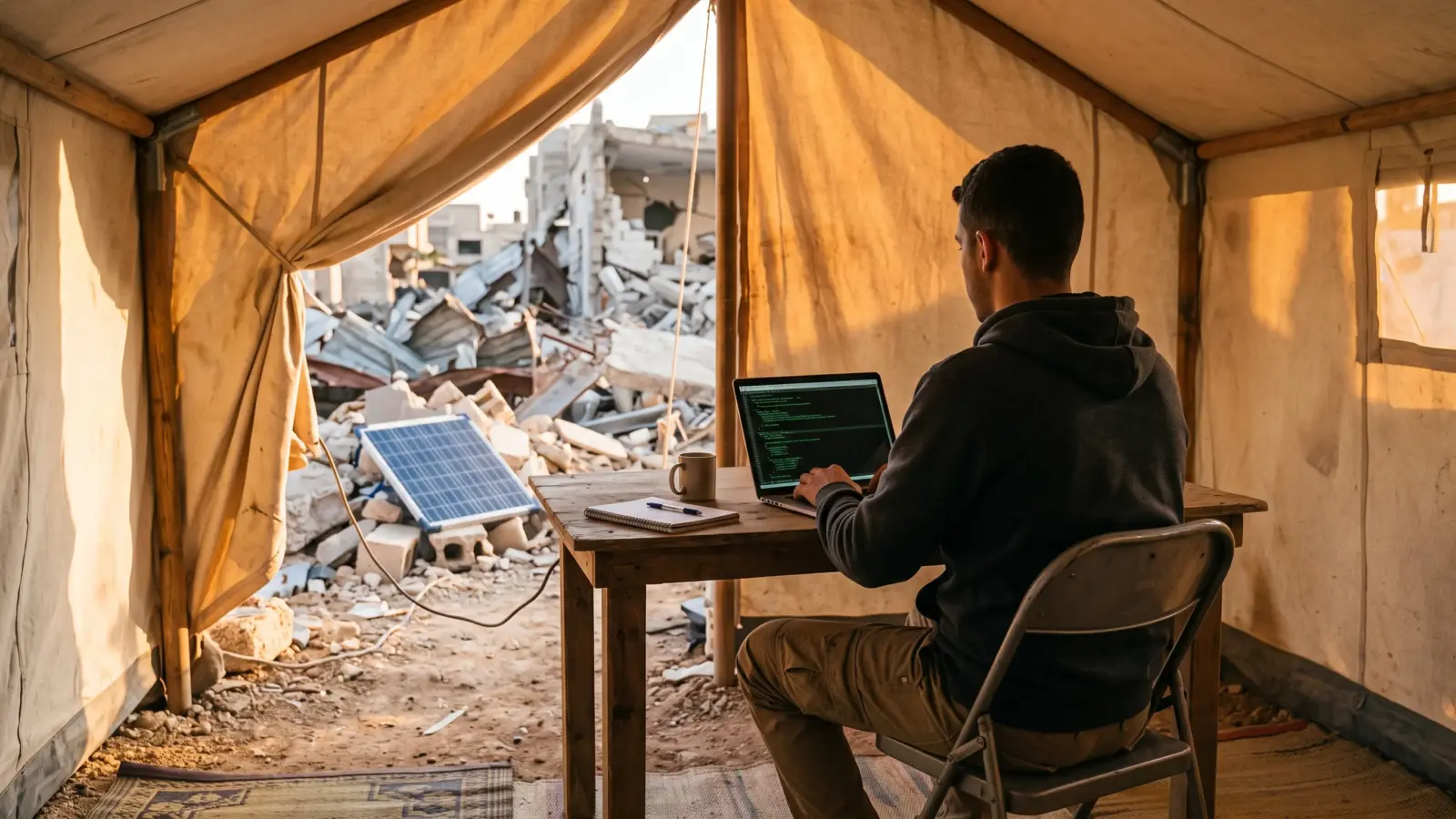

Hey everyone, Eyad here. This post is different from my usual ones, so no jokes today.
I write about software, and more of the software world than you’d guess runs on Palestinian tech talent. Freelancers in Gaza ship apps for clients in the Gulf. Engineers in Ramallah and Rawabi do contract work for chip and networking giants. Researchers at Birzeit University publish open-source Arabic language tools that anyone can install for free.
All of it was built under blockade and occupation. In Gaza, much of it has been bombed over the past three years.
So this is two stories in one post: what Palestinians have contributed to IT, and what the genocide in Gaza has taken from the people doing that work and from the children who should be next in line.
This one is personal. During my time at Kooora, the Arabic football site, I worked alongside several Palestinian editors. They were hard workers who always gave it their best. They also had a lot of trouble getting the job done, because the electricity wasn’t always there.
Keep that in mind as you read. The talent and the effort were never missing. The basics were.
Why I Use the Word Genocide
I’m using that word on purpose, so here is where it comes from.
In September 2025, the UN’s Independent International Commission of Inquiry on the Occupied Palestinian Territory concluded that Israel had committed genocide against Palestinians in Gaza. In June 2026 the same commission published a 94-page follow-up on children. It found that the genocide is continuing, with more than 20,000 children killed, and it treats the deliberate targeting of children as key evidence of intent.
A few honest limits. The commission was set up by the UN Human Rights Council and doesn’t speak for the UN as a whole. Israel rejects the finding completely. And the International Court of Justice, which is hearing South Africa’s genocide case against Israel, is years from a final judgment. Its current timetable for written arguments runs into 2029.
International and Israeli human rights organisations have reached the same conclusion as the commission. I’m not going to wait until 2029 to describe what the evidence already shows.
Palestinian Tech Talent Grew Up Under Blockade
Gaza’s digital economy exists because every other door was shut.
After 2007 the blockade crushed farming and manufacturing. Unemployment sat around 45% before the war and about 65% among young people. You couldn’t export furniture or strawberries, but you could export code, because code doesn’t need a truck or a permit.
More than nine in ten households in Gaza had internet before October 2023, according to the Associated Press. Graduates with laptops started selling design, writing, and programming to clients abroad.
Gaza Sky Geeks and the freelancer boom
The best-known hub is Gaza Sky Geeks (GSG), started in 2011 by the aid group Mercy Corps with a $900,000 grant from Google. In a March 2026 interview with StartupScene, senior programme manager Rand Safi laid out the numbers:
- More than 60,000 people trained by 2023, around 4,500 a year
- More than half of all participants were women
- Graduates of its freelancing programme, launched in 2017, earned more than $20 million online
- A new graduate made about $700 a month in the first six months, and experienced developers $2,000 or more
That last figure matters. Reuters put Gaza’s median daily wage at $11 in 2019. A remote developer earning $2,000 a month was making several times that.
How many people worked this way? Estimates vary a lot. A UN figure cited by Truthout puts it at around 12,000 online freelancers before the war. StartupScene’s estimate is 30,000 young people working online. I can’t tell you which is right, and I’d rather show you both than pick the bigger one.
The work itself is ordinary in the best sense. The AP describes a 44-year-old programmer in Gaza City debugging the barcode reader of a Saudi valet parking app. Others design logos for pizza places in Canada and build websites for businesses in Kuwait and Turkey. Thousands of Palestinians from Gaza are registered on each of Upwork, Freelancer.com, and Mostaql, the Arabic freelancing marketplace.
So if you’ve used an Arabic app or website built by contractors, some of it may well have been written in Gaza.
The West Bank: An Outsourcing Desk for Big Tech
The West Bank’s tech scene looks different. It has fewer solo freelancers and more companies.
The sector has more than 250 ICT companies, most of them small. ICT is short for information and communication technology, which covers software firms, telecoms, and IT services.
Job counts depend on who’s counting. A 2023 World Bank report put the sector at more than 8,500 people, while a newer industry estimate that includes indirect jobs says about 20,000. PITA, the Palestinian IT association, says around 40% of outsourcing firms export their work.
Some of those clients are very big names:
- Nvidia, via Mellanox. In 2019 Reuters reported that Mellanox, the Israeli chip designer Nvidia was acquiring, had given stock options to more than 100 Palestinian contract engineers in the West Bank and Gaza. They stood to share about $3.5 million.
- Cisco, Microsoft’s Israeli arm, and Wix. Pre-war reporting names all three among the companies using Palestinian engineers, directly or through outsourcing firms.
- ASAL Technologies. The firm behind the Mellanox work runs from Rawabi, the first planned Palestinian city, north of Ramallah.
Homegrown startups exist too. Mashvisor, a real-estate analytics company built in Ramallah, became the first Palestinian startup accepted into Silicon Valley’s 500 Startups programme back in 2016.
Its co-founder said at the time that a virtual market has no checkpoints. That’s true for the software, but not for the people who write it.
The UN’s humanitarian office, OCHA, counted 925 movement obstacles in the West Bank as of December 2025: checkpoints, road gates, and roadblocks that restrict 3.4 million Palestinians. That’s 43% above the average of the previous twenty years. A developer in Nablus can push code to a server in Frankfurt in seconds and still not know whether she’ll reach the office in Ramallah today.
Since the war began, the West Bank has also become the fallback for Gaza’s tech community. GSG now runs most of its operations from Ramallah, and its West Bank team has grown from four people to nearly twenty.
The Arabic Web and Open Source
This is the part I think gets the least attention, and as a developer it’s the part I find most impressive.
Computers handle Arabic badly by default. One written word can pack in a verb, its subject, and its object. Short vowels usually aren’t written. Spoken dialects differ so much that software trained on formal Arabic stumbles on everyday speech.
Fixing that is the job of natural language processing, or NLP, the field that teaches software to work with human language. Good Arabic NLP is what makes search, translation, and chatbots work properly for a few hundred million Arabic speakers.
SinaLab at Birzeit University, near Ramallah, builds exactly that and gives it away. Its toolkit, SinaTools, is open source under the permissive MIT license, and you can install it with pip install sinatools. It includes:
- Morphology tagging, which breaks Arabic words into their parts
- Named entity recognition, which spots people, places, and organisations in text
- Word sense disambiguation, which works out which meaning of a word is intended
- Utilities for tokenising, transliteration, and matching words with or without diacritics
The same lab publishes Wojood, a dataset for training Arabic entity recognition, along with an Arabic Ontology and Qabas, an open-source Arabic dictionary database. The team behind the toolkit paper is Tymaa Hammouda, Mustafa Jarrar, and Mohammed Khalilia.
If you’re building anything in Arabic, from a search box to an AI assistant, this is free infrastructure made in Palestine.
Gaza has an open-source story too. GSG’s Code Academy launched in 2017 with the London bootcamp Founders and Coders. Its curriculum lives on GitHub, where anyone can read it, reuse it, or send a fix.
What the Genocide Did to Remote Work
Remote work needs four things: a device, electricity, a connection, and a way to get paid. The genocide attacked all four.
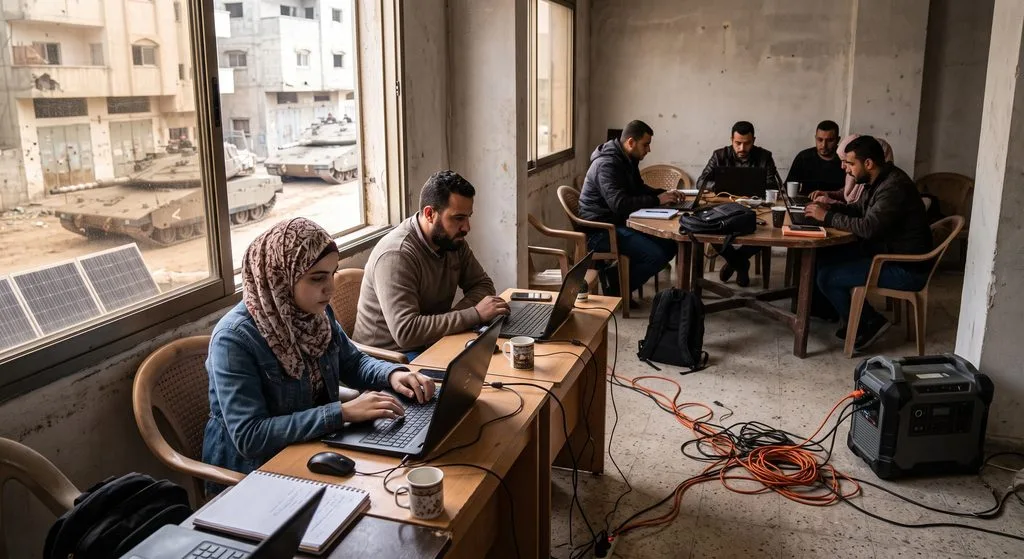
GSG’s Gaza City headquarters was destroyed within days. Two of its three locations were destroyed in airstrikes, according to the AP, and StartupScene reports that all three were eventually lost. Its staff inside Gaza went from roughly 36 people to five. Instructors, startup founders, and community members were killed.
According to AP reporting from May 2026, more than 75% of Gaza’s telecommunications infrastructure was damaged.
| Before October 2023 | 2026 | |
|---|---|---|
| Gaza Sky Geeks staff inside Gaza | About 36 | 5 |
| GSG coworking spaces in Gaza | 3 of its own | Lost; it now subsidises 5 independent spaces |
| Connectivity | 9 in 10 households online | More than 75% of telecom infrastructure damaged |
| Schools | Open | 98% damaged or destroyed |
| Getting paid | Banks open | Banks often inaccessible; transfer offices take 15-20% |
Safi says that from November 2023 to March 2024, most freelancers in GSG’s community weren’t working at all. They were moving from one shelter to the next.
One detail from that period has stayed with me. Freelancing platforms punish silence, and a profile that goes quiet loses its rating. So a group of Egyptian freelancers started completing assignments on behalf of displaced Palestinians, just to keep those accounts alive.
Not everyone had that help. A 22-year-old programmer told Truthout in September 2026 that when he finally found power and internet again, many of his clients had cancelled. He had to rebuild his profile from zero.
A designer in the same piece lost her income when unstable electricity fried her laptop. A replacement costs more than $1,000. Israel classes laptops, phones, and spare parts as “dual-use” goods and tightly restricts their entry, so they’re scarce.
The same report puts generator electricity at around $8 per kilowatt-hour. Money transfer offices take 15 to 20% of every payment. PayPal doesn’t serve Palestinian addresses at all.
How many remote jobs were lost in total? I looked for a verified number and didn’t find one. Thousands of careers were interrupted, and that’s as precise as the available data gets.
What’s being rebuilt
People are still working, which I find hard to get my head around.
- Taqat Gaza. Software engineer Sharif Naim opened a solar-powered coworking space during the war, with freelancers working in three-hour shifts. It now serves more than 500 of them.
- Gaza Talents. Salsabil Bardawi founded it after her husband and daughter were killed in 2024. It connects freelancers to international clients and has brought in more than $600,000, paid out through the Bank of Palestine and the PalPay wallet.
- GSG’s subsidy pilot. Since August 2025 it has covered internet and electricity costs for five independent coworking spaces.
Bardawi’s summary of what Gaza’s freelancers need is hard to improve on: “all they need is a laptop, internet, electricity and clients.”
Pro Tip: If you hire a freelancer in Gaza or the West Bank, agree on asynchronous deadlines instead of fixed meeting times, and ask upfront which payment route works for them. A week of silence usually means a power or network outage, so don’t cancel the contract over it.
A Generation Out of School
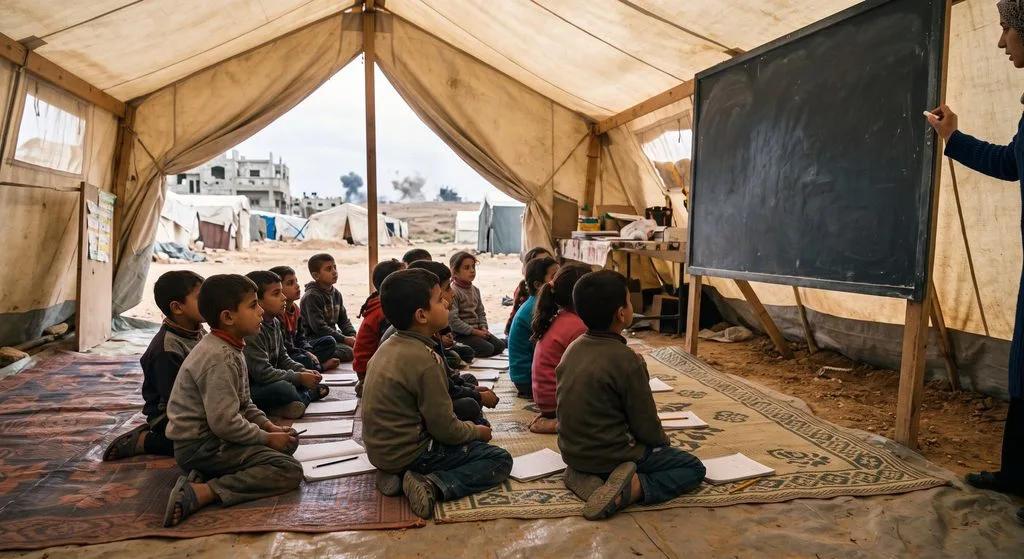
“Thousands” of children out of school would be bad enough. The real number is in the hundreds of thousands.
UNICEF’s April 2026 education update says about 700,000 children aged 4 to 17 missed formal in-person schooling for almost three school years in a row. Roughly 56,000 more reached school age during the war.
There is some newer and better news. On September 19, 2026, a new school year began. Reuters reported that hundreds of thousands of children returned to in-person teaching for the first time in nearly three years, with education officials expecting at least 540,000 in class.
“Class” is a generous word, though. UNICEF says 98% of Gaza’s schools were damaged or destroyed, so lessons happen in tents and patched-up buildings. Many families can’t afford notebooks and pens.
Universities are in the same state. UNESCO estimated that more than 95% of higher-education campuses were severely damaged or destroyed. Figures presented by Palestinian academics at a higher-education summit in April 2026 put the number of students cut off from university at more than 80,000. The Islamic University of Gaza restarted in-person teaching in late 2025 with four usable classrooms.
The commission’s chair, Srinivasan Muralidhar, said “Palestinian children will not simply recover overnight.” For tech, the arithmetic is brutal. A developer takes about sixteen years of schooling to make. A child who missed grades one through three is the junior engineer of 2040, starting three years behind.
And yet the demand to learn is enormous. In an August 2026 interview with PocketGamer.biz, GSG’s Leyan Zahdeh said its game development programme went from 150 participants last year to more than 1,000 registrations, with around 600 now training across Palestine.
They learn Unity and C#. The course is built around recorded sessions and small 2D projects, because live classes and large files don’t survive a dropped connection. Teams are capped at three people.
Students are building games through blackouts and displacement. I don’t have a clever line for that.
What You Can Do
I’m a developer, so I’ll stick to practical things.
- Hire. Search for Palestinian freelancers on Upwork or Mostaql, or go through Gaza Talents. Paid work beats sympathy.
- Mentor. GSG asks for two or three hours a month from experienced tech people.
- Host an intern. GSG says it will subsidise the cost. What graduates lack is real project experience.
- Use the open-source work. If you build in Arabic, try SinaTools, cite it, and report bugs.
- Be patient with outages. See the Pro Tip above.
The Verdict
Palestinian developers didn’t get into tech because conditions were good. They got in because code was the one export nobody could stop at a border. Then the infrastructure behind that export, and the schools behind the next generation of it, were destroyed.
Safi told StartupScene: “The human capital is there, and it is prepared.” I believe her. Palestinian tech talent was never the problem.
What’s missing is electricity, hardware, working banks, open roads, and classrooms. Those are political problems. No amount of coding fixes them, and the rest of us in tech shouldn’t pretend otherwise.
Frequently Asked Questions
What have Palestinians contributed to the tech industry?
Three main things: a large remote freelancing workforce in Gaza serving clients worldwide, West Bank outsourcing firms that have done engineering work for companies such as Nvidia’s Mellanox and Cisco, and open-source Arabic language tools like SinaTools from Birzeit University.
Why does this post call it a genocide?
Because the UN’s Independent International Commission of Inquiry concluded in September 2025 that Israel committed genocide in Gaza, and said in June 2026 that it is continuing. Israel rejects the finding, and the International Court of Justice hasn’t issued a final judgment.
How many children in Gaza missed school?
UNICEF says about 700,000 children aged 4 to 17 missed formal in-person schooling for almost three school years. In-person classes restarted in September 2026, mostly in tents and damaged buildings.
Can freelancers in Gaza still work remotely?
Some can. Coworking spaces such as Taqat Gaza provide solar power and internet, and groups like Gaza Talents help with payments. Many others lost clients, devices, or both.
How can I hire or support Palestinian developers?
Hire through Upwork, Mostaql, or Gaza Talents, volunteer as a mentor with Gaza Sky Geeks, or offer a remote internship. Agree on flexible deadlines and a payment route that works for them.