

Hey everyone, Eyad here.
Developers are having two panics at once. One says AI is about to take every coding job. The other says the AI bubble is about to burst and drag the whole industry down with it.
I see it mostly in LinkedIn posts and Facebook groups. The loudest voices are fresh graduates who can’t find a job, and new engineers who got replaced by an AI at a small business.
So, will AI replace software engineers? My take up front: no. But “of course not” is too comfortable an answer. Those fresh graduates aren’t imagining things, and the data backs them up.
Two Panics That Can’t Both Be True
If AI is good enough to replace engineers, the companies selling it are worth the money and there’s no bubble. If it’s a bubble, the tools are overrated and your job is safe from them.
You can’t lose your job to a technology that doesn’t work. Pick one panic.
The mistake is treating share prices and tool quality as the same thing. They’re separate questions, so I’ll take them one at a time.
The AI Bubble Is a Money Problem
A bubble means prices assume future profits that may never arrive. It says nothing about whether the product works.
The money side does look stretched. In the record of its September 2026 meeting, the Bank of England’s Financial Policy Committee said share prices for AI companies “fell sharply in July” and that a sharper correction is still a risk. It also cited a Morgan Stanley estimate that AI-related borrowing had reached around $450 billion by early September, more than double the total for all of 2025.
A painful correction is possible. If it comes, expect hiring freezes and dead startups. I’d bet on pricier AI subscriptions too, since so much of today’s AI is paid for with borrowed money.
What a correction won’t do is un-invent the models. The dot-com crash of 2000 wiped out a lot of companies, and the internet carried on. If prices do climb, local AI models are a decent fallback for everyday coding chores.
Will AI Replace Software Engineers? Here’s the Data

Three findings matter more than any LinkedIn post.
No mass replacement. Stanford’s Digital Economy Lab tracks US payroll records. Its August 2026 update found no widespread, economy-wide job losses tied to AI.
Juniors are falling behind. In the same update, workers aged 22 to 25 in the jobs most exposed to AI sit about 19% behind similar workers in less exposed jobs. A year earlier the gap was 15%. Experienced workers show no comparable gap. The lab’s monthly dashboard shows the same split inside software development: large declines for the youngest developers, growth for the older ones.
Most of that comes from companies hiring fewer young people, not from firing them. The authors also say these are patterns, and they can’t prove AI caused them.
The forecast is still growth. The US Bureau of Labor Statistics projects 10% growth in software developer jobs from 2025 to 2035, against 3% for all occupations.
| The claim | What the 2026 data says |
|---|---|
| AI is replacing all developers | No economy-wide displacement; developer jobs projected to grow 10% by 2035 |
| Nobody is affected | Workers aged 22-25 in AI-exposed jobs are about 19% behind their peers |
These are US figures, so read them as a direction, not a forecast for where you live.
Why the Tools Still Need an Engineer
The tools are good. Pretending otherwise is its own kind of panic.
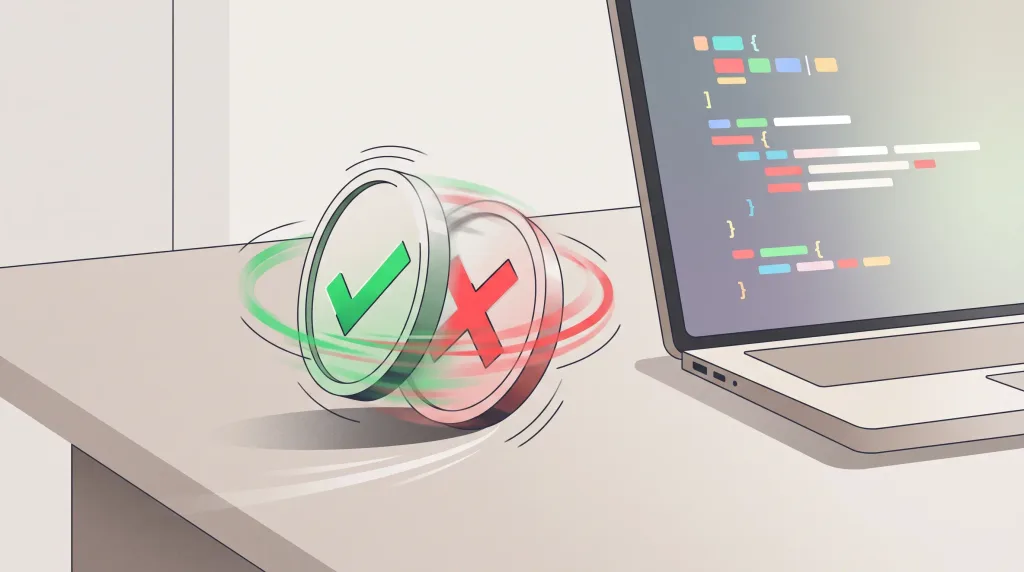
METR, a nonprofit that tests AI systems, estimated in mid-2026 that the best models can finish software tasks that would take a human expert 16 hours. The catch is the success rate: 50%.
A coin flip on two days of work is impressive. It also means somebody has to know which half failed.
Developers seem to agree. In Stack Overflow’s 2026 Developer Survey, 73% of respondents use coding assistants or agents every day. Asked when it’s acceptable to trust AI, the top answer, picked by 48%, was when they can easily check the result.
Stanford’s update offers a likely reason juniors are hit first. Jobs are shrinking where the work leans on codified knowledge, the kind you get from textbooks and documentation. They’re growing where it leans on tacit knowledge, the kind you only pick up from years of real projects.
My reading: AI has read every textbook. It hasn’t sat through your client’s requirements meeting.
I got my own reminder while building a plugin for Lexical, an open-source framework for building text editors. My plugin had some similarities to another one. So Claude Code copied most of that plugin’s data objects and attributes (the fields a plugin keeps track of) into mine, even though the new plugin didn’t need or use them.
When I pointed that out, it didn’t remove the unused code. It doubled down and kept the data in the plugin anyway.
I had to start from scratch. I told it the two plugins were not related, and I ended up writing most of the plugin’s architecture myself so there was nothing left to duplicate. After I was done, it made some brilliant suggestions for abstractions, meaning ways to simplify and reuse the code.
Both halves of that story are true. The tool made a mess that I had to design my way out of, and then it improved my design.
Typing code was never the whole job anyway. Working out what the client needs, deciding what not to build, and owning the result when production goes down are still human work. I compared the tools themselves in my CLI vs GUI AI coding post.
What to Do Instead of Panicking
- If you’re a junior: stop competing on typing speed. Build one project end to end, deploy it, break it, and fix it. Practice reviewing AI-written code, because that’s the part the tool can’t do for you.
- If you’re a senior: keep hiring and mentoring juniors. No juniors in 2026 means no seniors in 2035.
- If you run a team: don’t build your whole workflow on one vendor’s pricing. A market correction could change that pricing fast.
- Everyone: use the tools daily. Refusing them won’t protect your job.
Pro Tip: Ask the AI to write the tests before the code, then read the tests yourself. If you can’t tell whether a test is correct, you don’t understand the task well enough to accept the code.
The Verdict
AI won’t replace all software engineers. The profession is forecast to keep growing, and the best tools still fail half the time on long tasks.
The real worry is the entry level. Fewer juniors are getting hired, and nobody has explained where the next generation of seniors is supposed to come from.
As for the bubble, it may well pop. That would mean a rough year for tech salaries, and a useful reminder that a stock chart and a working product are different things.
Frequently Asked Questions
Will AI replace software engineers completely?
No. Stanford’s August 2026 analysis of US payroll data found no widespread displacement, and the Bureau of Labor Statistics projects developer jobs growing 10% from 2025 to 2035.
Is AI hurting junior developers?
The data points that way. Workers aged 22 to 25 in AI-exposed jobs are about 19% behind their less exposed peers, mostly because companies hire fewer of them. The researchers say they can’t prove AI is the cause.
Is there an AI bubble?
The Bank of England says AI share prices fell sharply in July 2026 and that a sharper correction remains a risk.
Should I still learn programming in 2026?
Yes, but learn it differently. Use AI tools from day one, and put your effort into design, debugging, and reviewing code.